2024 — 2025
Theory of Semantic Communications: Symbol Distribution Analysis
Explaining learned symbol distributions through a source–channel equilibrium
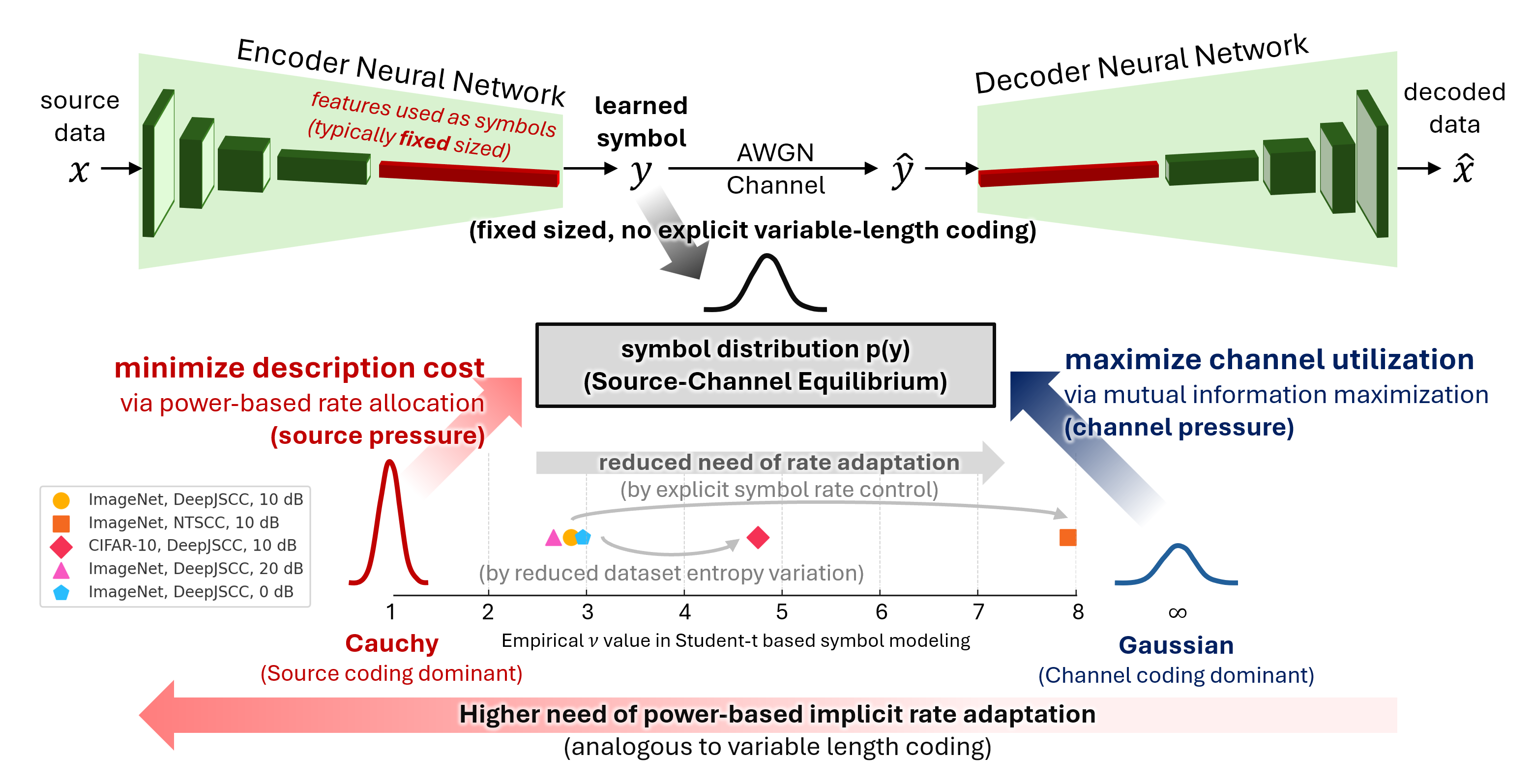
Semantic communication encoders often produce fixed-length, heavy-tailed symbols, but the reason for this shape has remained unclear.
We explain it as an equilibrium between two forces: source pressure, which minimizes description cost through power allocation, and channel pressure, which maximizes mutual information. Their balance leads naturally to a Student’s t-distribution.
Experiments show how explicit rate control and dataset entropy shift the learned symbols between Cauchy-like and Gaussian-like regimes. Distribution regularization also improves training convergence, supporting the proposed interpretation.
Related Publication
Hanju Yoo, Dongha Choi, Songkuk Kim, Chan-Byoung Chae, and Robert W. Heath, Jr., “Symbol Distributions in Semantic Communications: A Source-Channel Equilibrium Perspective,” IEEE Transactions on Communications, vol. 74, pp. 13842–13855, 2026.
Related Award
This work contributed to “Bridging Neural Networks and Wireless Systems: Theory and Prototypes for Semantic Communications,” which received the Honor Prize at the 31st Samsung Humantech Paper Award.