2026 — Present
Theory of Semantic Communications: Functional Interpretation of Neural Regions
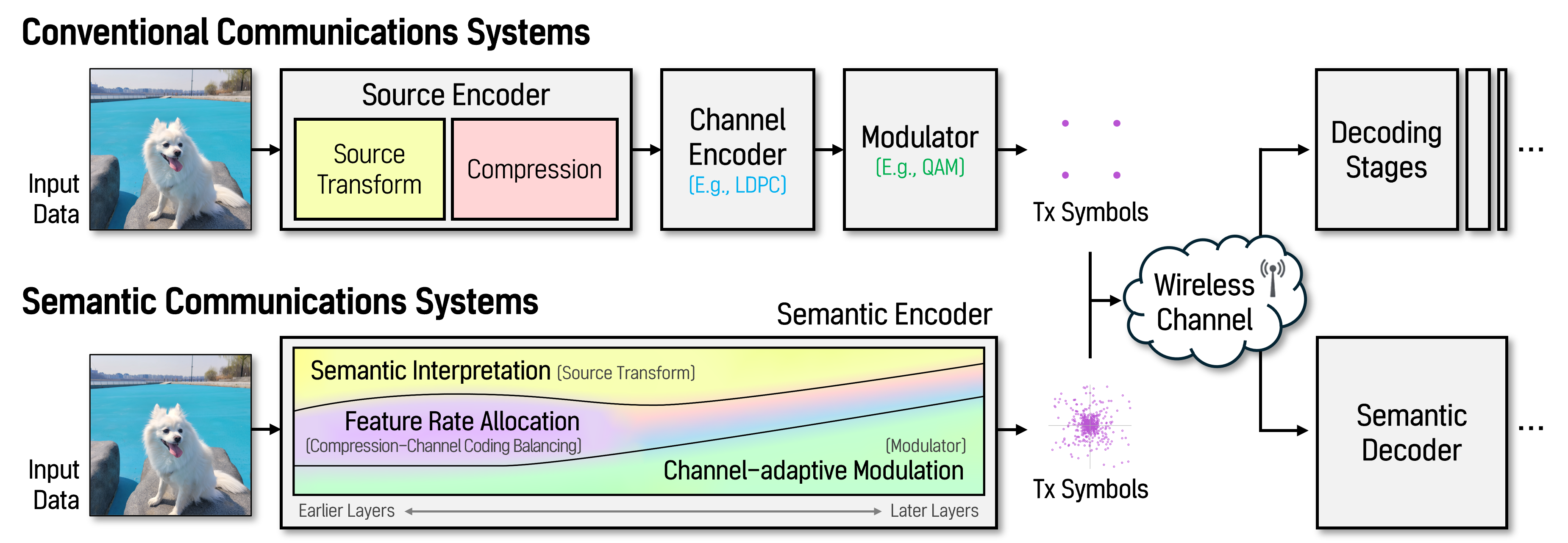
Explaining semantic communications in the language of conventional communications
Neural semantic encoders jointly perform source coding, channel coding, and modulation, but their internal organization is difficult to interpret.
We analyze the encoder across network depth and identify layer-dependent specialization: semantic interpretation, feature-rate allocation, and channel-adaptive modulation become dominant in different regions.
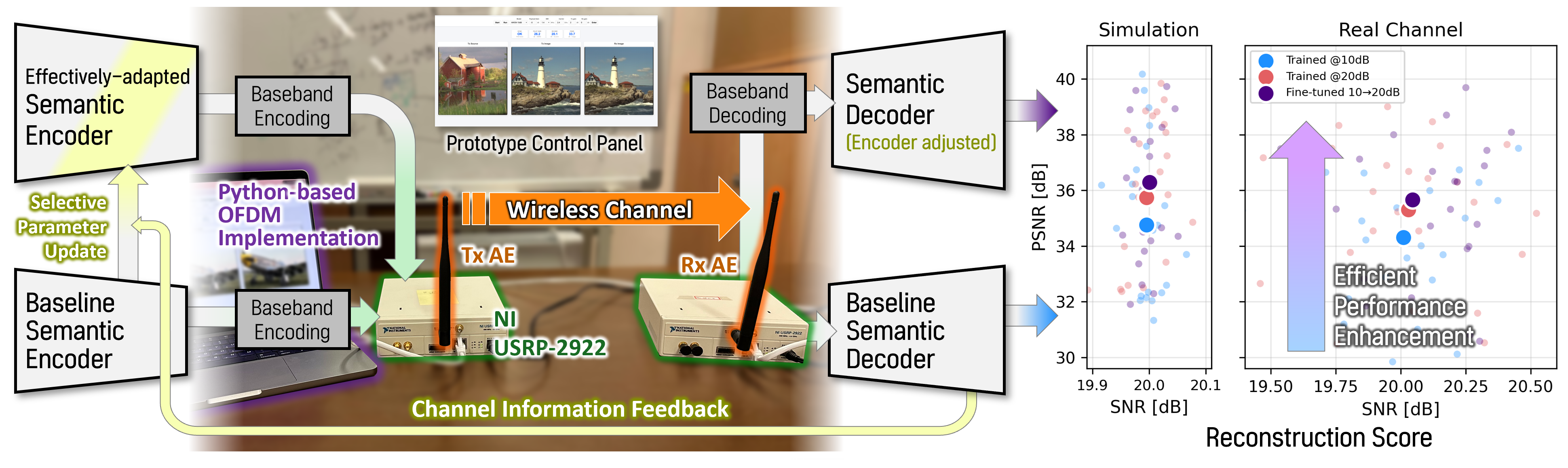
This interpretation enables selective fine-tuning. By updating only the encoder regions most relevant to channel adaptation, the over-the-air prototype improves reconstruction under channel mismatch without retraining the full model.
Related Publication
Dongha Choi, Hanju Yoo, Kyungpil Lee, Dongwook Kim, and Chan-Byoung Chae, “Explainable Semantic Communications: Neural Encoder Interpretation and Prototype Validation,” under major revision for a special issue of IEEE Communications Magazine.