2025 — Present
Secure Semantic Communications via Steganography
Deceiving eavesdroppers to discourage attack attempts in semantic communication systems
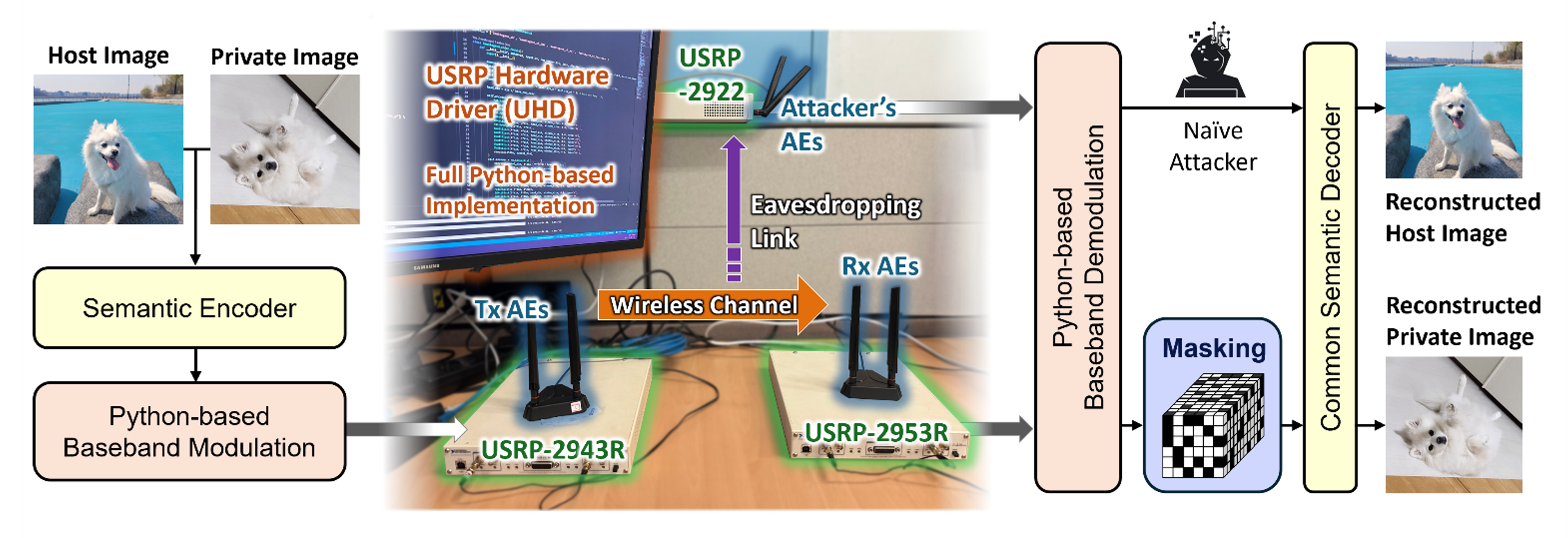
Host and private images are encoded together into shared wireless symbols. A receiver without the key reconstructs only the host image, while an authorized receiver applies a pre-arranged channel mask to recover the private image as well. Both paths use the same semantic decoder.
Training combines reconstruction fidelity with a marginal push-away loss that keeps private information out of the unmasked symbols:
A securely shared mask acts as the key, allowing only the authorized receiver to recover the private image.
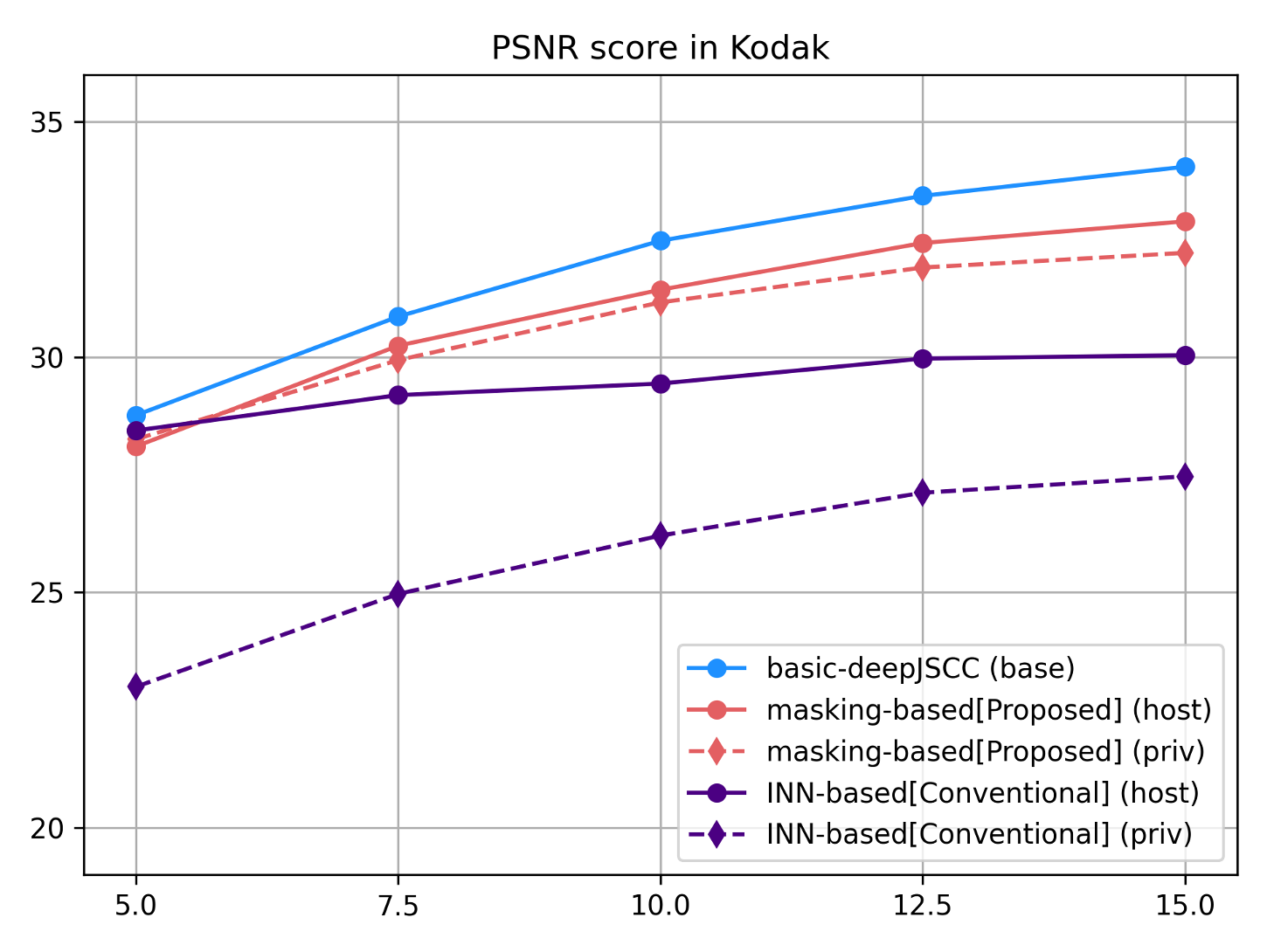
We validated the method on a Python-based, LTE-compliant 1.4 MHz MIMO-OFDM testbed with NI USRP radios. Over-the-air results outperformed the secure baseline while remaining close to standard deepJSCC.
Related Publication
Dongha Choi, Hanju Yoo, and Chan-Byoung Chae, “Steganography Semantic Communications: Architectures and Prototype Validation,” to be submitted.
Related Demonstrations
This system was demonstrated live at IEEE GLOBECOM 2025, held December 8–12, 2025, in Taipei, Taiwan.